
3. Peace and Dialogue Centers
Characteristics of the Four Peace and Dialogue Centers
3.1 STRUCTURE
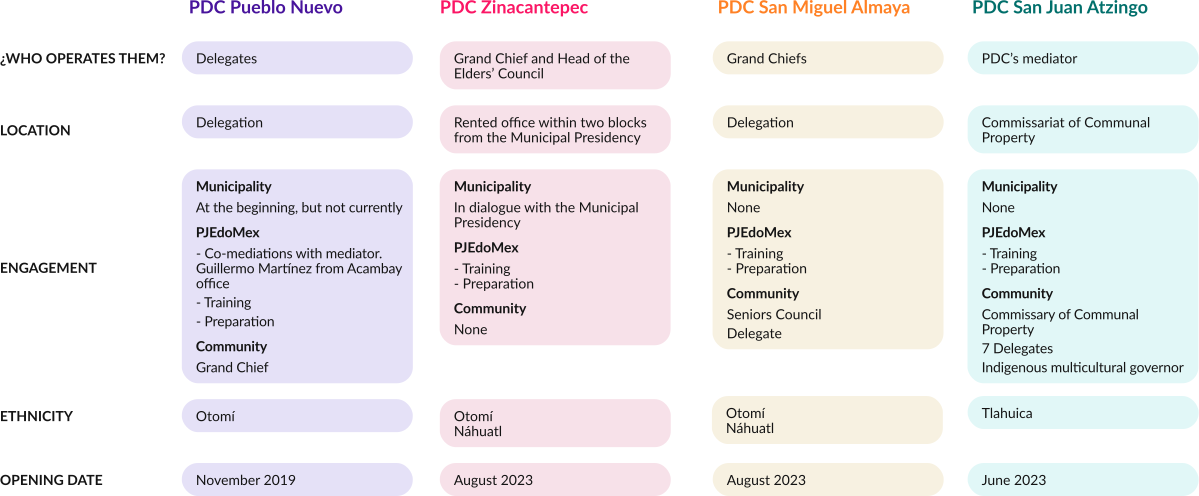
Main characteristics of PDC
3.2 CONFLICTS
Each community presents problems and aspects specific to its context. However, there are conflicts that were identified as common to all, including land-related conflicts, family conflicts, criminal conflicts, and violence against women and girls.
Some family conflicts, such as home abandonment, are combined with access to basic services, like medical attention or adequate food for women and minors, factors that diminish quality of life.
Land-related conflicts are frequent and have to do with boundaries, water supplies, irregular land sales, clandestine logging, or even damages because of flooding due to widening roads. Likewise, a common theme in these communities is violence against women and girls in different forms, such as psychological, physical, and sexual violence, which almost always occurs between family members.
Director, Peace and Dialogue Center, San Juan Atzingo.
Family conflicts, in general, are about inheritance, divorce, teenage pregnancy, alimony, and the care of minors. Guadalupe Corona, president of the Council of Elders of Zinacantepec, described the situation as follows, “in Santa María del Monte, there are many girls who are minors and already have two children”.
There are also other problems such as access to drinking water, drainage, or electricity, which is due to the remoteness of the communities, or the lack of support they receive from the municipalities, among other factors. On the other hand, there are also criminal conflicts, such as fights or injuries among community members, in addition to the consumption of psychoactive substances.
3.3 THE MEDIATOR PROFILE
Currently, the operation of the Peace and Dialogue Centers (PDCs) is managed by community members who hold various positions of authority, including delegates, Grand Chiefs, Chiefs, presidents of the Council of Elders, and members of the Commissariat of Communal Property.
At the same time, those operating PDCs have some type of training or previous experience in conflict management, either because they were delegates and conciliated family conflicts, or they were conciliators who mediated land conflicts at the Commissariat of Communal Property.

Oswaldo Pérez Dávila, Grand Chief, San Miguel Almaya
In addition to their social and cultural position within communities, two other factors contribute to their community legitimacy. First of all, their familiarity with problems and the internal norms including uses and customs necessary to solve them. Secondly, the social and cultural recognition they have within their communities. Both are important aspects considered to be elected in assembly for a certain community position; and consequently, a virtuous circle of legitimacy and respect before the community is generated.
An important aspect for validation and community recognition is knowledge of the indigenous language which all mediators (and those in the process of becoming mediators) possess, even if their level of speech and understanding varies. Likewise, their work and community participation are relevant, for managing resources, organizing tasks, promoting language recovery, or addressing specific conflicts.
President of the Council of Elders, Peace and Dialogue Center of Zinacantepec.
Their tools and legal knowledge as operators vary – the PDCs from Pueblo Nuevo and San Juan Atzingo have a legal background, in contrast to those of Zinacantepec and San Miguel Almaya. The level of training received by the operators from the PJEdoMex Mediation Center on alternative mechanisms, communication, and conflict resolution techniques also varies.
3.4 ROUTE OF THE CONFLICT
Peace and Dialogue Centers were designed to aid users from the locality or community where they are situated. However, sometimes they also provide services to neighboring communities, which may be from the same or different ethnicity, such as Tlahuica, Otomí, or Náhuatl.
The aim is to find solutions that seek to solve problems, to guarantee repair of damage, or the relationship, as well as to reach a commitment of non-repetition.

Peace and Dialogue Center, Pueblo Nuevo (facade)
Delegates guide and direct users to the Centers in Pueblo Nuevo and San Juan Atzingo. For instance, prosecution operators from the municipal seat of Ocuilan refer cases to San Juan Atzingo’s PDC, as well as the Commissary of Communal Property who is responsible for referring land conflicts to the PDC.
Once a user arrives at the PDC, the process begins with a recounting of the conflict. The mediator informs them of different strategies or possible ways to address their conflict in a first session, offering the jurisdictional or mediation route. In that same session, users decide which route to follow and, if they will choose mediation or conciliation. The PDC appoints the person involved to attend a session on a specific date. Sometimes these sessions take place at the PDC, or also directly on the land involved in the conflict, for example, when a boundary measurement is required. The mediator allows both parties to intervene and, if there is willingness, they draw up an agreement or a solution, for example, of mutual respect, reparation of damage, or any other. If the parties so wish, this is recorded in a document or agreement signed by both parties. The aim is to find solutions that seek to solve the problem, guarantee a reparation of damages or the relationship, and reach commitments for non-repetition.
There is a tendency for individuals to comply with agreements, as they are the ones to propose the solution.
Director, Peace and Dialogue Center, San Juan Atzingo.
This document protects them within their community or before other authorities, but it does not have the value of a final sentence, unless validated by the Mediation Center of the PJEdoMex. The ambivalence of the value of this agreement constitutes a challenge faced by PDCs, addressed later in this text.
The PJEdoMex Mediation Center provides assistance either by validating agreements or through co-mediation, where the PDC mediator collaborates with the PJEdoMex mediator. This has occurred only in Pueblo Nuevo, though not systematically.
3.5 BENEFITS
The benefits of the Centers directly impact the quality of users’ life given their proximity, low costs, timely and effective resolution of problems with cultural relevance, and the guidance they receive.
In some cases, PDCs are not limited to conflict resolution, but are a space where people receive useful information to manage their affairs, which has an impact on their autonomy and legal capacity.
When discussing the benefits of PDCs, interviewees mentioned different types of advantages or benefits they have obtained from these services. Some are related to their accessibility, both in terms of geographic location and cost. Other benefits are linked to the timely and effective resolution of problems, since it avoids escalating the conflict or going before a judicial or prosecuting authority. Additionally, benefits also relate to reparation to individuals or the community as part of the resolution, as pointed out by Óscar Alejandro Muñoz, president of the Council of Elders of San Miguel Almaya, "...a sanction will make you come and sweep this space, or go cut the grass at a certain school". These actions also strengthen the sociocultural organization of the indigenous communities and, with it, the ethnic identity and the community’s social fabric.
User of the Peace and Dialogue Center, San Juan Atzingo.
“The San Juan Atzingo PDC is there, precisely, to provide assistance to indigenous people”, commented Lidia Ángeles, PDC Mediator, so that another benefit of PDCs, aside from serving communities, is to have mediators who come from those same communities where the problems arise, that is, mediation or conflict resolution taking place with cultural and linguistic relevance. Ernesto Palma, secretary of the Municipal President of Zinacantepec, explained that, in this sense, the expectation is that the facilitator understands and, in some way, is immersed in the specific worldview of the community in a current context, so that they can defend the interests of these groups. By living with them directly, problems can be prevented from escalating or being framed erroneously. In addition to this cultural relevance, PDCs have the potential to be enabling spaces for recovery and promotion of community values and practices, such as the use of language during mediation or the conciliation process, since, as is the case with the Tlahuica language, in some communities it has already been lost or is in the process of extinction.
User of the Peace and Dialogue Center, San Juan Atzingo.
3.6 DAILY OPERATION
The Pueblo Nuevo and San Juan Atzingo Centers operate during office hours and, although they have some furniture and other resources, they lack basic necessities, such as computer and printing equipment, stationery, and soap for cleaning.
“There has been no support. That’s why whoever is here becomes frustrated, because they get here, and then what? What do they get in return? What if they have a family? That's the problem.”
(Marcelino Domingo Barragán, Pueblo Nuevo Grand Chief)
Regarding the financial remuneration for individuals operating PDCs, it practically amounts to nothing, except for the San Juan Atzingo mediator, who receives a bonus agreed upon by the Assembly of Land-owners (in Spanish, Comuneros), although payment has not been constant. The lack of income is a complex issue that was approached with concern, distrust, and as a factor that interrupted Center operations.
This concern is shared by all, both PDC and PJEdoMex members. The absence of a clear administrative structure for the Community Peace and Dialogue Centers represents an obstacle. In addition, areas for improvement have been identified, such as the lack of a financial management model for the supply of inputs and data collection for generating efficiency indicators. Sergio Valls, general director of the Mediation, Conciliation and Restorative Justice Center of the PJEdoMex, pointed out that these weaknesses emphasize “the need to strengthen administrative and economic infrastructures to optimize Centers’ operations and effectiveness.”

